

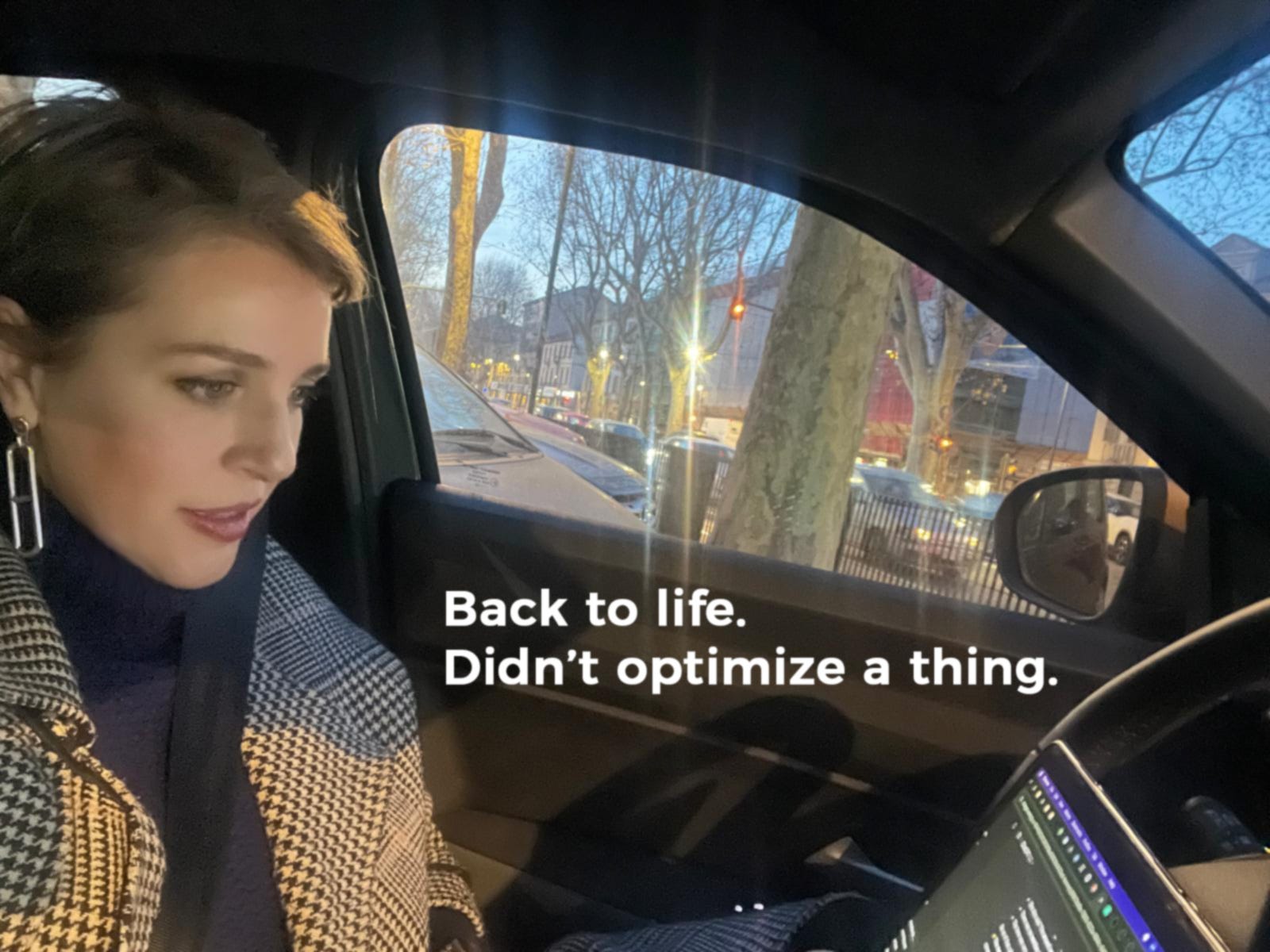
Every year, especially around the holidays, I fall for the same psychological trap.
I imagine long stretches of uninterrupted time where I’ll finally catch up on everything: reading, writing, thinking, exercising, and producing. I picture myself industrious and returning from the holiday season feeling accomplished and ahead of the curve.
Then there is reality.
Almost nothing gets done. There is no significant output to justify all that “free time.”
What does surface is my willingness to do everything but what I intended to do over the holiday. Distract myself with should-nots: shop (overspend), eat things I swore I wouldn’t touch, get lost online, binge-watch TV series, then sleep in the next day.
This year was no different, except that for the first time since I was a kid, I didn’t try to fight it. I allowed myself to intentionally become reacquainted with boredom and see what that was like.
Why “What Is My Purpose?” Is Everywhere
One concern I hear repeatedly from people, especially those in their forties and fifties, is simple and heavy at the same time:
“I don’t know what my purpose is.”
I’ve been hearing some version of this question for years, across different professions, different levels of success, and very different life circumstances. People who are accomplished, capable, and who have done many things “right.”
When I look at earlier generations, especially my parents’ boomer generation, I’ll sometimes hear remarks like, “People today just don’t know what they want anymore,” usually followed by a “When I was a kid, I had to walk 10 miles barefoot in the snow to school every day” speech.
I digress. If what earlier generations say is true, it’s hard to believe people were once “better” and now they are “worse.” Maybe it has more to do with the environment we’re living in.
Now we have more, and then we had less: options, comparisons, filters, technology, resources, information.
More. Faster. Better. Easier.
Careers, money, experiences, freedom, and all the comforts that come with those things don’t seem to resolve the underlying and intensifying restlessness.
It’s worth stepping back and asking why this sense of void, this obsession with life purpose, persists in people who, on paper, already have everything they need. If we’re bombarded with noise and constantly sold the idea that purpose is an external achievement, how surprising is it that people start looking for fulfillment in the next job role, the next city, the next relationship, or the next “new and improved” version of themselves?
People often dismiss phrases like “everything you need is already within you” as spiritual fluff. Fair enough. Taken at face value, they can sound vague or detached from real life. Stripped of mysticism, though, what those phrases are pointing to is far more practical than people give them credit for.
Clarity and strength do not arrive through accumulation.
As I approach my forty-eighth birthday, one thing has become obvious to me. A sense of purpose and life satisfaction doesn’t come from chasing more. It takes shape through consistently honoring a set of values in everyday choices.
Knowing what you stand for, what matters to you, and what you’re not willing to compromise simplifies life in ways that are difficult to appreciate until you’ve landed on your rear a few times. Over time, values tend to sharpen, especially if you allow life to teach the lessons it insists on teaching, rather than trying to outsmart, bypass, or avoid them.
It would be convenient if fulfillment came with a painless, step-by-step formula. It doesn’t. There is no universal sequence of actions that guarantees clarity, just as there is no single method that guarantees success, wealth, or satisfaction. Each life carries its own constraints, responsibilities, and trade-offs, and no one is exempt from difficulty.
What seems to make the difference is a willingness to make choices that align with personal values, even when those choices are inconvenient, uncomfortable, or unimpressive on paper, and even when more exciting alternatives are available.
Over time, this way of living produces concrete effects. Decisions require less internal negotiation. The mental chatter dies down. Confidence stops being something you try to perform and starts being something you simply are. Purpose tends to show up quietly. I stayed stubbornly ignorant of it for years, and then there it was, all along.
From Chasing to Consequence
It is January, which usually brings an urge to fix everything at once. Gym memberships, language courses, financial spreadsheets, and ambitious plans suddenly feel urgent.
None of these things are inherently wrong. They can be genuinely useful when they serve a clear intention.
A gym membership can be about external validation, or it can be about wanting a body that feels strong and capable enough to share life with the people you love. Learning a language can be an attempt to compensate for a sense of inadequacy, or it can be a way to engage more deeply with others and expand perspective.
The good news is that purpose does not require grand gestures or dramatic reinvention. The less flattering news is that it often asks for acceptance of realities that don’t align with our fantasies about what life should look like. What tends to follow, though, is a form of satisfaction far more interesting than the imagined happiness we project onto alternate versions of our lives.
Life may be stranger than fiction, but given the chance, it can be more compelling too.
Where I Am Now
As I write this, work continues to arrive from different directions.
That’s been true since 2005, when I became a single mother, and even more so since 2011, when I moved to Italy with my daughter and no real support system. Taking on different roles wasn’t a strategy. It was necessity. For a long time, I wondered and worried about what my purpose was.
There was a period of my life when, if people asked what I did for a living, my most honest answer was some version of:
“What month, day of the week, or time of day is it?”
At some point, I labeled myself a multipotentialite. At least it was a word that helped give shape to something that otherwise felt undefined.
Looking back now, I remember those years with a mix of fondness and relief that I never have to live through them again. They were often rough, but full of curiosity and exploration.
I still move across different kinds of work, but something fundamental has shifted inward. I’m no longer preoccupied with trying to define myself. My sense of achievement gradually became a consequence of keeping my word and honoring the commitments I chose to take on.
When I brought a child into this world, when I took animals into my care, when I accepted responsibility for people, work, and situations, I made a promise to follow through. Most adult decisions since then have been shaped by that.
It isn’t glamorous or always enjoyable. It would have been easier to walk away more than once. I didn’t. Over time, that consistency does its work.
I’m not in a phase of chasing momentum or trying to manufacture inspiration. I’m allowing the consequences of those choices to unfold. So far, I haven’t felt the need to interfere.