

Bello Papá
On the days I work from home, I have lunch with my parents.
For the past two weeks, I’ve eaten a piadina (sandwich) nearly every day.
Piadinas, a type of flatbread that originates from the Emilia-Romagna Region, have gained increasing popularity throughout Italy, especially in the past few years.
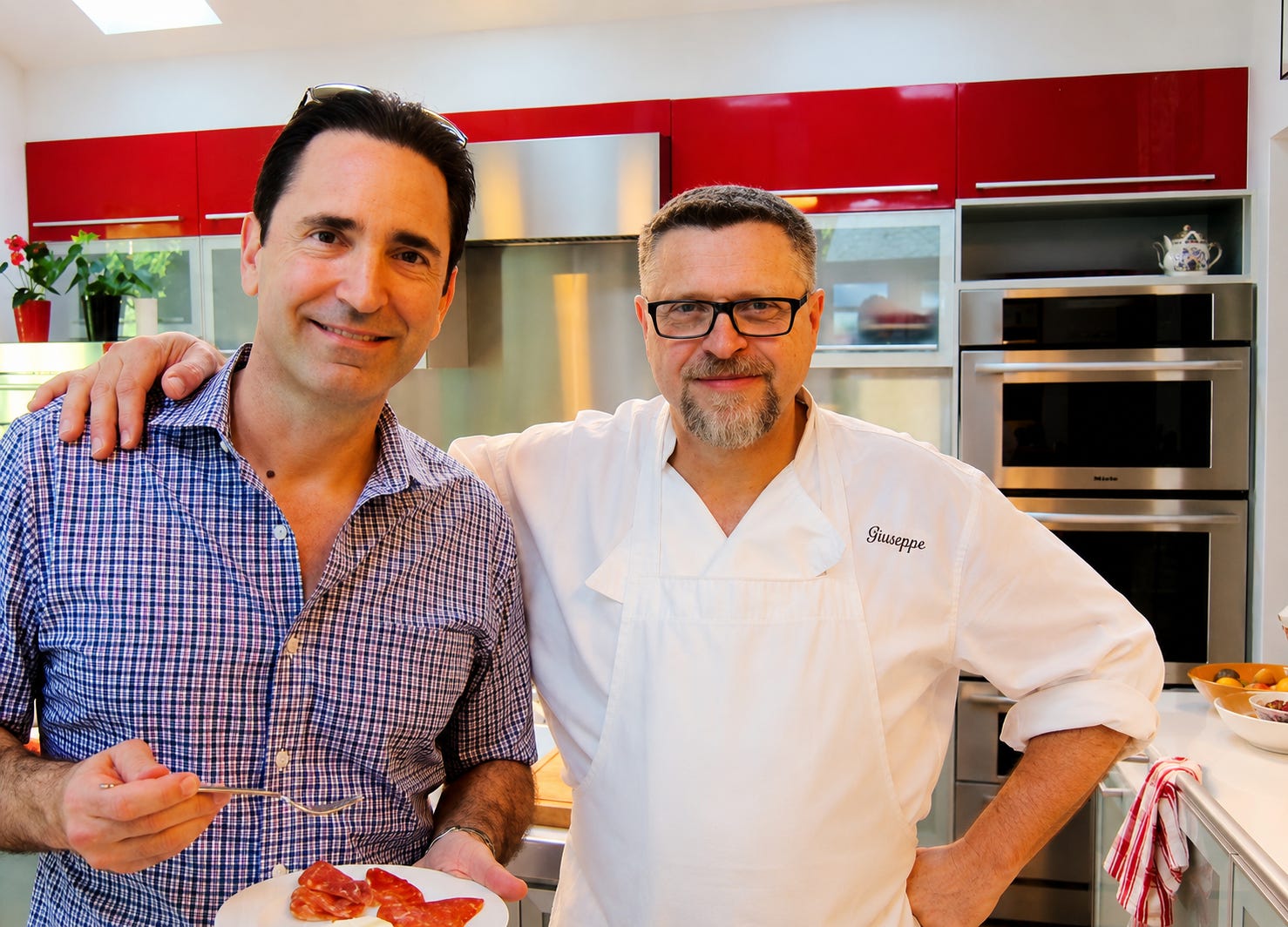
They’re light, easy, inexpensive, tasty, and you can grab them on the fly all over town, and lately, in Giuseppe’s kitchen.
Have I mentioned that my father, since he’s been retired, doesn’t leave the house unless he has to?
Now hold that thought and combine it with knowing that there are certain things he prides himself on being “cheap” about.
One of those things is not spending money on pre-prepared foods. That includes foods from supermarkets or restaurants. So that naturally means we make a lot of things at home that most “normal” families just grab off the grocery store shelf.
What he isn’t cheap with is calories. Nor has he ever been particularly concerned with the relationship between food and health. He prioritizes flavor above everything else, so oil, salt, and anything else needed to make something powerfully tasty are not spared.
However, his “just do it yourself” mentality (which is mainly tied to his frugality and perfectionism) has not only made every family member a potential contestant on the reality TV show Survival, but has also kept us from eating pretty much anything processed.
So, unintentionally, I’d say we have healthier eating habits than the majority of the population simply because my father insists we look at the price per Kilo and pay as little as possible for everything we buy. Whatever, it works.
Now, at home full-time at the age of 73, the man spends his days rebuilding 1/2 the house and making a mess in the kitchen for us girls to clean up.
When he worked full-time, he used to do those things on the weekends. I can’t recall a moment in my life when our family home wasn’t under construction.
I don’t think a week has gone by without my mother complaining, “I can’t stand the dust anymore!”
But now that he doesn’t have a job to go to anymore, he just busts everyone’s chops at home with his full-time hobbies. Let’s just say that if you knew Giuseppe personally, you’d understand he is truly living his best life. And the women complaining about their diets, flour everywhere, and tools in the middle of the kitchen, have yet to be a deterrent.
Growing up with Mr. Delena (in the temporal sense) can mostly be defined by phases of temporary obsessions: focaccia, cheese, roasting coffee beans, hamburger buns, spicy oil made from his own peppers, and pizza. Whatever captured his attention became a mission.
His perfectionism wasn’t limited to food. It extended to wall surfaces, business plans, aesthetics, grammar, posture, logic, and occasionally, complete strangers on television. No one was spared.
In his world, “perfect is good enough.” Except “perfect” never arrives.
Believe me when I say that man is not for the weak at heart.
Now that I’m once again living at home, every day, after lunch, my dad makes two cups of espresso. One for me, and one for himself. He puts all the fixings in it, just the way I like it, stirs it, and serves it to me. And while we’re drinking it, he asks, “What are we having for dinner?”
On the days I don’t have time to linger around the table and have to rush to an online meeting, he walks up to my office and quietly serves me in the background, making sure no one online can see him.
In those cases, shortly after I’ve had my coffee, I sometimes get a WhatsApp message from him: “What should we make for dinner?” Or a mid-afternoon phone call from the main floor, “What would you like to eat tonight?”
Our lives revolve, and always have, around food.
Drama.. Passion.. It’s all the same thing.
You know Dirty Harry? Take away the gun, and give him a set of lungs, and you’ve got Giuseppe.
The upside to that is you never have to guess what he’s thinking; the downside is you always know what he’s thinking.
The commandments
Being a part of his circle of trust requires following certain guidelines, and while they’ve always been clear, as a kid, it takes time to get them right.
The Italian side of my family has been raised around the table for generations.
And while many of the fundamentals seemed rooted in food themes, it took me years to understand the deeper meanings, and that food has simply been the main vehicle.
Our character development and value system on themes such as discipline, gratitude, respect, priorities, timing, family, resourcefulness, and standards were boiled, fried, and garnished, and it pretty much went something like this:
What’s that still on your plate? Eat it. = your resources are precious, don’t waste them.
The family sits down and eats together = Respect your family, share with others, take time for the people that matter to you
When it’s time to eat, drop what you’re doing and get your butt to the table = respect other people’s time, manage your own accordingly, and understand that some things don’t revolve around you
Eat and shut up = this is not a democracy
Don’t overcook pasta = respect tradition and pay attention to what you’re doing
And those are just the top 5 reasons why, in our family, food and emotional intensity go hand in hand: tears, laughter, yelling… pasta, oil, garlic, salt, tomatoes, and onions have always been present, or somehow involved in our dramedies.
Mamma mia!
My mother, being American, didn’t always get it right, and oh man, when she didn’t, the whole neighborhood knew.
As aforementioned, my father came equipped with a powerful set of lungs, which he can either use as a weapon of mass destruction or to woo the most kindred souls.
When he threatens to use his “opera voice”, it usually doesn’t mean the latter version, which, when we were kids, produced countless tears. As adults, it produces endless comedy.
Some would call it extreme.
He calls it perspective.
My mother calls him an “Asshole,” to which he replies, “You say that like it’s a bad thing.”
Food as a religion
Let’s talk about GOD.
My father has a first name, a last name, and nothing in the middle.
Years ago, while at Best Buy purchasing a new large-screen TV, the salesperson stood before him, filling out a form.
Please spell your first name:
“G-I-U-S-E-P-P-E”
Last name?
“D-E-L-E-N-A”
Your middle initial?
“O”
The salesperson looks up at him and says, “Your initials spell GOD?!”
My father, “Yes, exactly.”
Many would faint to hear such sacrilege. But not papá. He is not a lover of the church for a variety of reasons.
One of those reasons is tied to his strong attachment to logical thinking. He’s always questioned the purpose of “faith,” so much so that he doesn’t even believe in Atheism, because, as he puts it, “You’d have to be sure that there is nothing. I’m not sure of anything.”
What an oddly humble analogy coming from a man who’s incredibly sure of his worldview.
In any case, while he may not be a believer in the Bible, his unwavering devotion to food manifests in almost religious ways.
While others say grace, he says, “buon appetito.”
While people close their eyes when they pray, he closes his when he’s done eating and says, “Goddamn, I ate too much… where are the oranges? You want one? Then go get me one while you’re at it.”
Religion is a matter of interpretation
The holidays are particularly important to him.
Why?
Again, it’s not because of Christ; it’s because it’s an excuse to have a huge feast with our family and friends.
About 10 days out, while, of course, sitting around the table, the conversation starts like this:
Christmas is a little over a week away. Who’s coming?
We discuss the potential guest list.
“What are we making for antipasti?”
We usually decide on 3 or 4.
“What about the ‘primi?” A ‘primo’ is Italian for the first course. Notice I use the plural word “primi.” That’s because there’s no way in hell (no pun intended) he’s going to agree to make just one. I usually end up negotiating him down to just 2: A pasta and maybe soup or rice.
“The secondi?” - the second course. This is also plural for the same reason. After much discussion, we usually choose about 2-3 types of meat and/or fish, accompanied by 3-4 different vegetable dishes.
After that, we serve cheeses, nuts, desserts, and finally, coffee and grappa. Or, as my sister likes to call it, “Crappa.” It’s an acquired taste.
It never fails that while we’re creating the menu, I say, “Papá, we’re making enough food for an army. There’s no way anyone can eat all that.”
My father: “What are you talking about? (in the usual bombastic tone he uses when he rejects a statement that contradicts his thinking). I don’t want people to starve when they come over!”
Then, once the guests leave, he inevitably says,
“We made too much food. Where are we going to put it all?”
Then the strategy for food preservation begins.
And so it goes, every holiday without fail.
While we didn't go to church, we were raised watching the head of the household peel fruit and pass slices to everyone at the table, as though each meal were the Last Supper.
There have essentially been sermons on how to twirl your pasta properly. Every non-Italian guest who has shown up at our house over the years has left capable of handling spaghetti properly.
We’ve performed miracles by transforming tasteless dishes (obviously cooked by somebody else) into something worth eating simply by adding some “more oil and salt.”
And if you think this is me recounting my life through some cheesy metaphor, let’s talk about sunny-side-up eggs and dried basil.
The Egg Heresy
When I was 10, I was spending more time in the kitchen. On a beautiful Sunday morning, I made my dad sunny-side-up eggs.
They were perfect! As I placed them on the plate, my eye caught a glimpse of dry basil, and I thought… Scratch that, I don’t know what in the world I was thinking. Let’s chalk it up to me just being a kid.
Anyway, I sprinkled the eggs with the basil and placed them in front of my papá. As I turned back towards the stove, I heard a fist pound on the table, and in his full “opera voice,” he emphatically pronounced, “What happened to these eggs?”
I sheepishly replied, “I put basil on them.”
In a decibel fit for announcing the end of the world, he asks, “Why would you do that?”
Mustering up all the courage I had, I uttered, “I thought I’d try something different.”
And finally, he replies with the words that still burn in my memory today, “Don’t get creative with my eggs! Don’t mess with my food. Food is my religion!”
In a normal household, most fathers would say, “Oh, sweetie, thank you for making me breakfast.”
Nope, not papá.
And the egg incident was far from being unique as I learned to cook over the years.
“You’re using the wrong knife!”
At 13, I quickly learned that you don’t use a chef’s knife to cut bread, a bread knife to cut cheese, or a steak knife to cut a tomato. Using the wrong knife was not something you wanted to get caught doing. I still wouldn’t be able to tell you if stealing would have been considered a greater offense.
As my father puts it, “Use the right tools for the job.”
It’s too sour. It’s too sweet. It needs more salt. It could use more oil.
At this point in my story, it’d be easy to conclude that I hate to cook. I assure you, I’ve loved cookbooks since before my teens, and the sparkle of high-quality cookware at Williams-Sonoma still tickles my fancy and entertains many of my fantasies.
Cooking remains one of my greatest joys, and I am truly fluent in food, and much of this is due to my father’s unforgiving palate.
His constant constructive criticism was always equally matched with many words of encouragement and appreciation for what I did, indeed, do right. And it was through both feeling terrified of using the wrong knife and being lifted enough to be courageous and face a challenge, that I learned to discern between what tasted right and what did not. It ultimately led me to become an expert at balancing flavors.
A national pastime
If you’re not from Italy, you probably think lasagna is lasagna and pesto is pesto. Not even close.
Italians will and do spend hours arguing about whether a recipe is authentic, whether a sauce is made correctly, or whether someone’s grandmother would approve.
Case in point: my mother had always proudly told us that her grandmother on her father’s side was half Cherokee and half Blackfoot. She always explained, “That’s why I have high cheekbones, and my skin tone has red undertones, especially when I get hot.” Never mind that my mother just looks like a white lady with fair skin.
After taking a 23andMe test, my sister surprised my mother on her 67th birthday with the results of her bloodline. Native American: exactly... zero.
Now imagine what sentiment that must have produced in my mother, and apply it to some months later, while in the Dolomites with our entire family from Bologna.
My grandmother was an exceptional cook, but she didn’t originate from Bologna; she was raised between Napoli and Bari. When my grandparents moved to Bologna after having my father, she adapted to her new home by cooking the local cuisine. Ragú alla Bolognese became a staple in her kitchen.
I can still remember her standing over her tiny stove as she sauteed carrots, celery, and onions in a pot, then adding beef, and a little sausage (they’re big on pork meat in Emilia-Romagna), maybe some chicken livers, then simmering it in a splash of red wine, stewed tomatoes, salt, pepper, and... nutmeg.
My father’s siblings, having all grown up in Bologna, had married people whose families had been in Bologna for generations.
On that mountain trip, while we were all relaxing at a bar, a rather heated debate broke out about Ragú alla Bolognese because my uncle’s wife and mother were arguing that nutmeg does not belong in the original recipe!
My father briefly experienced the culinary equivalent of my mother’s DNA test results.
When it comes to Italians and food, it’s practically a national pastime. It’s always about who’s right and who doesn’t know what they’re talking about; let’s just say, entire friendships, marriages, and regional rivalries have survived (or not survived) less.
So the next time you think you’re publishing some cool “Italian recipe” on social media, I’d check your sources if you think anyone in Italy could see it. An Italian will think you’re hilarious and make an example of what he or she sees as an abomination.
There are entire reality shows built around people arguing about food.
And this is where I tell you, I was on one of those shows.