

I recently watched I Don’t Know How She Does It, a 2011 flick starring Sarah Jessica Parker.
Anyway, I had two reactions at the same time.
While it was cute, funny, and inherently true on many fronts, it still felt distant from my personal experience.
The forgetting of the school fundraisers, and scrambling what to do at the last minute, showing up late for the thousandth time, with that side look of disapproval from the teachers, to the perfect smiling moms that turned to talk crap about me the minute I was down the hall… all rang true.
Here’s where my story was different.
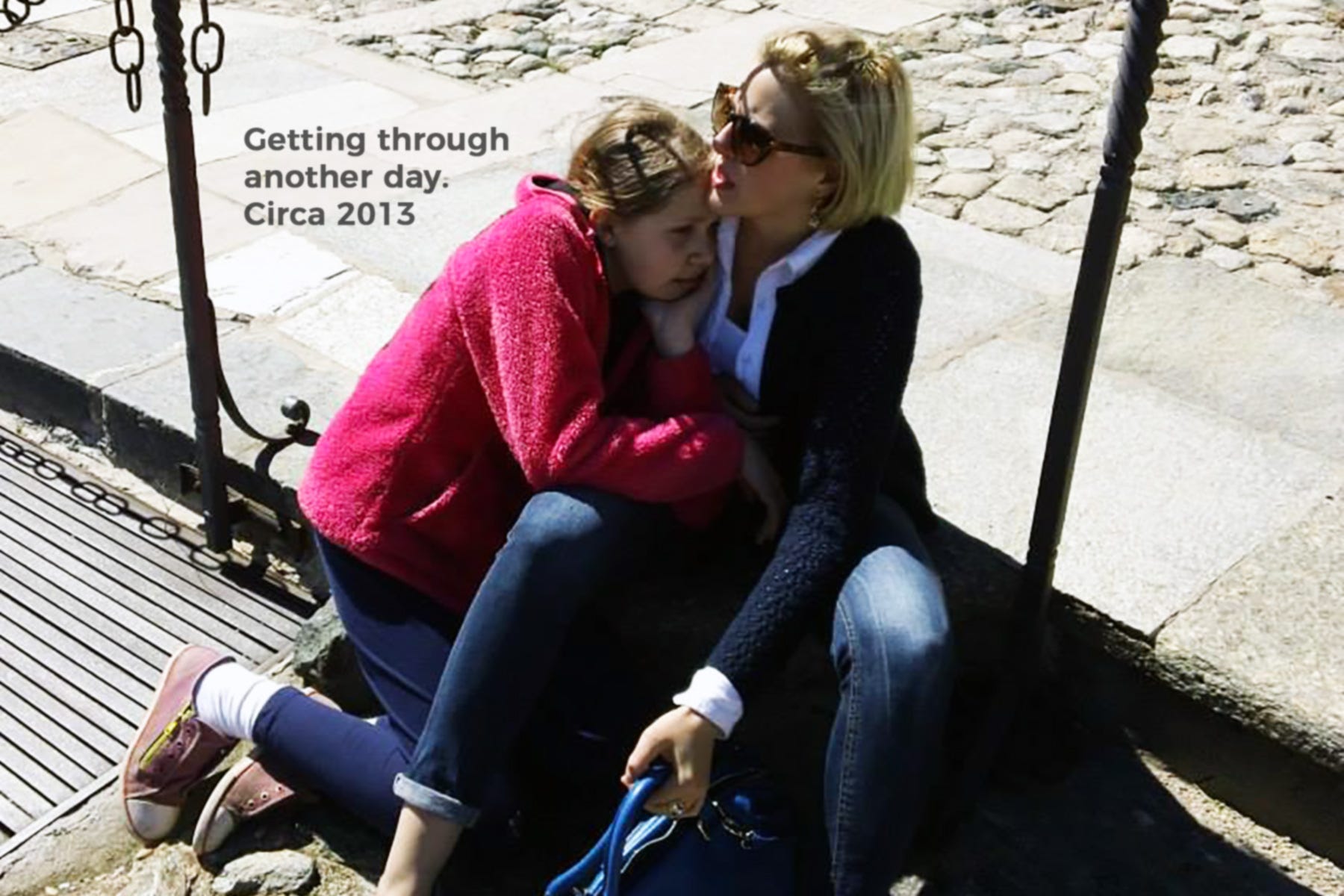
I was trying to build a life across the ocean, in a country I’d lived in as a kid but not as an adult, raising a child alone while trying to build a professional career (as a freelancer) at the same time.
I used to brag, “I’m a one-man band.”
A friend once looked at me when I said that, and asked, “Yeah, but how good is your music?”
I’ll never forget that. How the truth stings.
There was no system; there was just getting through the day, the week, the month.
I’d love to share what led me to a life choice most people reacted to the same way: “You’ve got balls… but that sounds insane.” But that’d be too long a footnote.
Once upon a time, when roles were clearly defined, family life generally made sense. Being a stay-at-home mom while your husband is at work all day isn’t everyone’s cup of tea.
Of course, the arrangement was (and still is) logical for many reasons; it worked well, and in many ways, it was also unfair.
Kudos to those who still happily enjoy a good old-fashioned household, as long as everyone is on board with it. My family was set up that way growing up, and, admittedly, I, the kid in the situation, loved having my mother home to cater to my needs.
She made my siblings and me the best costumes, and our lunches and after-school snacks were always ready. When we got sick, no problem, there she was, ready to kiss our forehead.
A few months ago, I walked into a deep conversation at a party between a few men and women. I think a few of them had small children. One person turned to me and asked me in front of everyone,
“Do you think women or men should stay at home with the kids?”
I replied, “Wow! The luxury of having such a choice! Well, I think healthy couples have a good partnership. If I had had an ideal partner for my needs, I think we would have done what made sense for us as a couple. I don’t think there is a right or wrong answer to that question; there is only what makes sense for two people with shared goals.”
It sounded good. It’s actually what I believe, and certainly a good theory.
Unfortunately, it wasn’t a reality I had experienced.
I thank the women who took a stand to get us what we wanted and deserved: to be treated as equals, to step into the world professionally, to build something of our own, to contribute, to compete, to not be confined to a single role even if we choose to have a family.
It’s totally amazing, and amazingly complicated at the same time, because the roles haven’t disappeared.
They’ve just overlapped. And guess who carries that overlap?
In Italy, they say, “You wanted the bicycle, now pedal.”
And so the women who want a career and still opt to have children pedal—and hard.
In my case, it felt more like dragging large stone blocks up a hill with a rope over my back.
When people talk about single parenthood, they usually imagine two people who had a child together, split up, and still share the responsibility.
That’s one version.
And it’s hard, of course it is, but there’s still a rhythm to it. There are breaks, handoffs, even if imperfect, there’s some form of shared responsibility.
Then there are other, more intense versions.
There’s the one where one parent isn’t physically present but contributes financially, so at least one part of the equation is held.
There’s the version where someone chooses to do it alone, but does so with enough stability, or enough support, to build something around that decision.
And then there are situations where one parent is neither present nor financially supportive, yet somehow still manages to remain involved just enough to complicate things.
That was closer to my reality.
Kids, do not try it at home.
It’s not the kind of situation you even consider until you’re in it.
I’m not going to sugarcoat it. I wouldn’t wish it on my worst enemy.
There’s a reason families were designed around two people, and it’s not just about logistics.
Because yes, juggling (at some point) you get the hang of it.
You become efficient in ways you didn’t know you could be, and sometimes it even gives you a strange kind of confident energy, because it proves to you that you can pull off what once felt impossible.
I’m not saying help wouldn’t have been nice, of course it would have been. It would have been great!
But what’s missing isn’t just help.
It’s having someone there to interrupt you when your own mind and emotions start running too far ahead of you.
Someone to say,
“You’re overreacting,”
or “You’re tired,”
or “Maybe don’t make that decision right now.”
When the other 50% is missing, it means that everything runs through a single channel.
And that gets exhausting in a very specific way.
Every parent knows how triggering kids can be. Our human lives are deeply shaped by our primal wiring, and I think most moms feel like a lioness with her cubs every once in a while.
It’s almost funny when you look back at it.
Almost.
If I had to name the most consistent emotion I felt as a parent, it would be guilt.
Not in a dramatic way, just… constant.
Guilt for getting too angry sometimes.
Guilt for not keeping promises I fully intended to keep (that one I really hate).
Guilt for working too much.
Guilt for not working enough.
Guilt for not being able to give my daughter the experiences I wanted her to have.
Guilt for the choices I made.
Guilt for the family I couldn’t recreate.
And I could probably keep going, but at some point it starts to sound ridiculous, even to me.
Time, I think, is the only thing that softens that.
As kids become more independent, you get to become, ironically, the workaholic you never had the luxury of being before.
Well, you can always count on them needing money. That gets worse, not better, with age.
At one point, you start to feel lucky if they choose to spend any time with you. And if they do still want to spend time with you when they’re independent enough, then it’s probably because all of your screwups weren’t bad enough for them to disown you.
Our life was a lot of figuring things out as I went, trying to be everything at once: provider, parent, decision-maker, emotional anchor.
What that looked like wasn’t impressive.
It felt like I was good at almost everything, but an expert at nothing, and I couldn’t clearly define what it was I did.
It looked like a hot mess most days, and still moving forward anyway.
Life has taught me this lesson many times over. There are infinite shades of gray between black and white.
Today’s younger generations have a strong desire to make clear distinctions between right and wrong.
I didn’t always have work conditions where my boundaries were respected, and rather than make decisions I couldn’t be proud of, I dove into the abyss of unknown consequences, trusting that I’d land on my feet with at least one of my other 500+ skills.
Being resilient like that gives you something most people don’t talk about:
the ability to choose, even when the options aren’t good.
Even if your kids aren’t directly involved in the decisions you make, they pick up on it. Maybe not consciously, but it’s there.
And at some point, it hits you that all of those decisions, big and small, are shaping the person who’s looking at you as their reference point for how the world works.
And maybe that’s part of the story too.
Because when you spend years living in that kind of tension (making decisions without a safety net, constantly switching roles, constantly second-guessing yourself) you don’t come out of it “balanced.”
You come out of it… adapted.
So when we talk about giving women equal rights, I think it’s fair to say that simply flipping the script and calling it progress is just two sides of the same coin.
It’s more of a reaction than a solution.
Effective solutions come from honestly assessing what doesn’t work and responding to it accordingly. I don’t know how far you can get just doing the opposite of what’s broken.
Talk of masculine and feminine energies has become a bit of a pop culture thing at this point.
I don’t see that as a man-versus-woman conversation.
If anything, I think we get stuck when we turn it into a question of who embodies what.
The point is that different qualities exist, and they tend to complement each other. And when they do, things tend to run more smoothly.
The structure matters less than the dynamic.
I’m not saying any of this to criticize the changes that have taken place; those changes were necessary.
Still, the world we live in isn’t as obvious as we sometimes present it.
Reality lives in the decisions people make quietly, in the trade-offs they carry without announcing them, and in the versions of strength that don’t look impressive from the outside.
So what was left for me?
The luxury (if you can call it that )of finally going full throttle on my career goals.
A lifetime of never-ending interruptions eventually gives way to a life with fewer interruptions.
And now that I’ve become masterful at functioning inside chaos, it’s baby steps towards learning how to walk down a quieter path.
There’s no elegant version of motherhood.
Not the ambitious one.
Not the present one.
Not the “balanced” one.
Just different ways of carrying the same weight, sometimes going a little mad in the process.