

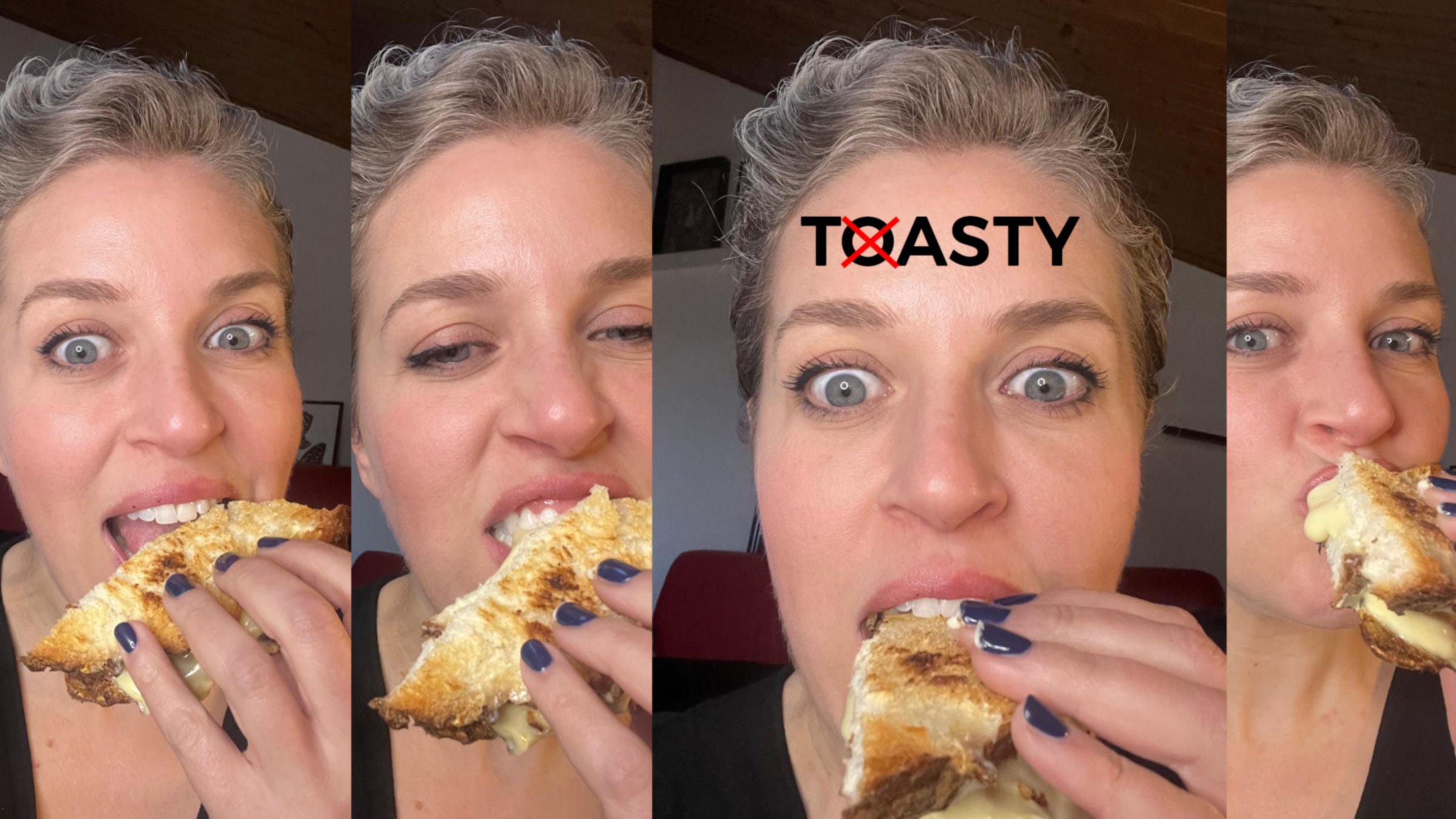
I used to think grammar didn’t matter. Then I learned Italian, taught English, and discovered that knowing the rules—and toasting bread—are simply tastier.
That’s the question every language learner wrestles with at some point.
And like most things in life, the answer isn’t black or white.
For those who know me, you already know I don’t do absolutes.
It’s a doggy dog world (yes, I thought that was the real phrase — until ChatGPT set me straight 😆), but somebody’s got to talk about it.
The Great Grammar Debate
There are two main camps.
On one side:
“You can’t build without a foundation. Grammar is everything.”
On the other:
“Grammar doesn’t matter. Just speak!”
These arguments have been around forever — textbooks versus street talk, theory versus practice.
Both are wrong — or rather, both are incomplete.
I’ve learned that the truth sits somewhere in the middle.
(Thanks for that one, Buddha!)
My Early Belief
For years, I believed grammar wasn’t essential — or even necessary.
I’m American. And even though I was raised by my overachieving, perfectionist-with-OCD father who likes to say he’s “not politically correct, but grammatically correct,” some of that classic American “it’s good enough for who it’s for” attitude still rubbed off on me — especially when it came to grammar.
“Let’s just focus on speaking,” I’d tell my students.
After all, that’s what my Italian clients wanted anyway. They’d been hammered with grammar throughout school and were paralyzed with what I like to call Grammar PTSD (Post-Traumatic Stress Disorder) whenever they had to speak.
Since that’s how I learned Italian at eight — through experience, not rules — I assumed the same would work for everyone.
It does... but only up to a point. That method works until the learning plateaus — and it’s not as efficient as it could be.
At the time, I didn’t yet understand how age affects language acquisition — how children, teens, and adults all learn differently.
Children learn to speak first and study grammar later. Young brains absorb patterns instinctively.
(If you want to get nerdy on this point, give me a ring — I’ll happily give you the lowdown.)
Adults, on the other hand, already have a complete first language — full of rules that shape how they think and speak.
When you add a new language on top of that, you’re not starting from scratch; you’re translating a whole system.
In other words, if you’ve played baseball all your life and suddenly switch to golf, you’ll need to unlearn a few things first (for example, smart working isn’t really a thing in English), then learn the new rules, and apply them while you’re still trying to hit the ball straight.
So, Should You Learn Grammar?
It’s not mandatory — but yes, especially if you pair it with experiential learning.
Grammar and mechanics are like the toasting process of a grilled-cheese sandwich.
Communication works without it — but it’s crispier, tastier, and way more satisfying with it.
It also helps with:
Confidence. When you understand why something works, you stop second-guessing yourself.
Speed. A little structure can dramatically accelerate your progress.
What grammar shouldn’t do is paralyze you.
If rules become the focus instead of communication, your brain stays stuck in thinking mode — the slow lane.
The Thinking Brain vs. The Performing Brain
We have two systems at play:
🧠 The Thinking Brain — slow, deliberate, analytical.
It’s what you use when you calculate 2343 × 2365.
⚡ The Performing Brain — fast, instinctive, automatic.
It’s the one that instantly blurts out 1 + 1 = 2.
When we learn something new, we rely on the slow brain.
When we master it, we move into the fast one.
That’s why you can’t learn to ride a bike by reading about balance.
At some point, you’ve got to fall off a few times and feel what balance means.
Language works the same way.
If you spend all your time memorizing rules, you’ll never develop fluency.
But if you ignore the rules entirely, you’ll keep tripping over invisible obstacles.
So — do both.
Learn the rules. Then break them through experience.
The Magic Mix
If you’re over 10, and especially if you’re over 18, grammar will help you make sense of what you’re hearing and saying.
But don’t let perfectionism stop you.
Throw yourself into awkward, messy, beautiful conversations.
People don’t care if you make mistakes — they care that you’re trying.
Be curious. Ask questions.
Laugh at your errors.
Speak imperfectly, often.
That’s how the fast brain learns to dance.
A Final Thought
My perspective comes from curiosity — and a lot of trial and error.
I’ve spent years studying communication science, reading linguists like Steven Pinker, diving into cognitive psychology, training with negotiation coaches, and experimenting with different ways to help my clients communicate better.
Every mistake, every awkward moment, every lightbulb taught me something.
Through mistakes, I learn consequently. Through teaching, I learn intentionally.
So if you want to truly figure out English grammar — or anything else — try explaining it to someone else, in your own words, in a way that makes sense to you.
Because when you can teach it, you’ve mastered it.
You want to dance? Then go ahead, make my day.
P.S. That was an invitation to comment. Make it happen. :)
It’s interesting how you articualte this nuancd perspective on grammar. How do you envision the 'middle ground' between foundational rules and conversational fluency evolving, especially with new AI tools for language learning, given your very insightful analysis?